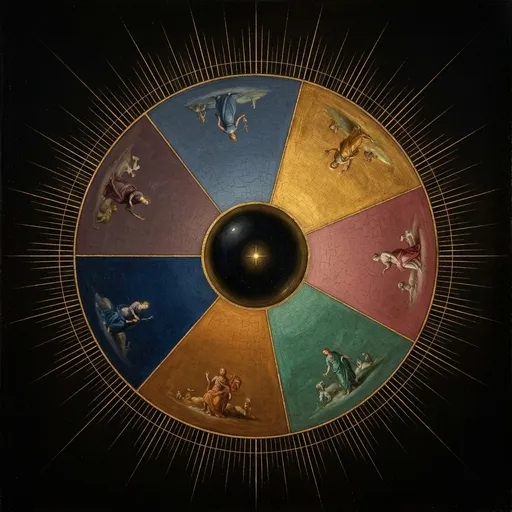
Methodology · Psychometric & Classical Framework
How we measure the seven virtues
The 7 Heavenly Virtues Test translates a 1,600-year-old ethical taxonomy into a clean, modern self-reflection scale—designed to be readable without a dictionary, resistant to acquiescence bias, and honest about the hidden costs of character strengths.
I. Why the Seven Contrary Virtues?
In Western philosophy, two distinct lists of seven virtues coexist:
- The Seven Contrary (Heavenly) Virtues—Humility, Charity, Chastity, Kindness, Temperance, Patience, and Diligence—codified from Aurelius Prudentius’s fifth-century allegory Psychomachia as direct behavioral counterweights to the seven capital sins.
- The Cardinal & Theological Virtues—Plato’s four cardinal habits (Prudence, Justice, Fortitude, Temperance) joined by Paul’s three theological virtues (Faith, Hope, Charity) in Thomas Aquinas’s Summa Theologiae.
Our primary wheel uses the Seven Contrary Virtues because each axis maps cleanly onto concrete everyday friction: ego threats (Humility), scarcity calculations (Charity), fragmented attention (Chastity), social comparison (Kindness), impulse regulation (Temperance), provocation (Patience), and effortful follow-through (Diligence).
II. Item Design & Scoring Formula
In Standard Mode, each of the seven virtues is measured by four behavioral statements rated on a five-point Likert scale from Strongly Disagree (0) to Strongly Agree (4). Express Mode uses the calibrated 14-item core subset (two items per virtue).
To prevent "halo clicking"—where respondents agree with every positive-sounding line—selected items are reverse-keyed (scored as 4 − raw). Each virtue’s raw sum out of 16 (or 8 in Express Mode) is normalized to a 0–100% score. Ties are broken first by strong-endorsement count and then by canonical order.
Your primary and runner-up virtues map onto a 7 × 7 composite matrix of 49 archetypes, while your lowest-scoring virtue identifies your "unguarded door" under fatigue or stress.
III. Primary Sources & Empirical Literature
- Peterson, C., & Seligman, M. E. P. (2004). Character Strengths and Virtues: A Handbook and Classification. Oxford University Press / American Psychological Association.
- Schnitker, S. A. (2012). An examination of patience and well-being. The Journal of Positive Psychology, 7(4), 263–280.
- Dunn, E. W., Aknin, L. B., & Norton, M. I. (2008). Spending money on others promotes happiness. Science, 319(5870), 1687–1688.
- Duckworth, A. L., Peterson, C., Matthews, M. D., & Kelly, D. R. (2007). Grit: Perseverance and passion for long-term goals. Journal of Personality and Social Psychology, 92(6), 1087–1101.
- Prudentius, A. C. (c. 410 CE). Psychomachia; Aquinas, T. (c. 1270 CE). Summa Theologiae, II-II.
Scope note: This assessment is an educational and recreational character-reflection tool, not a clinical, medical, or hiring instrument.